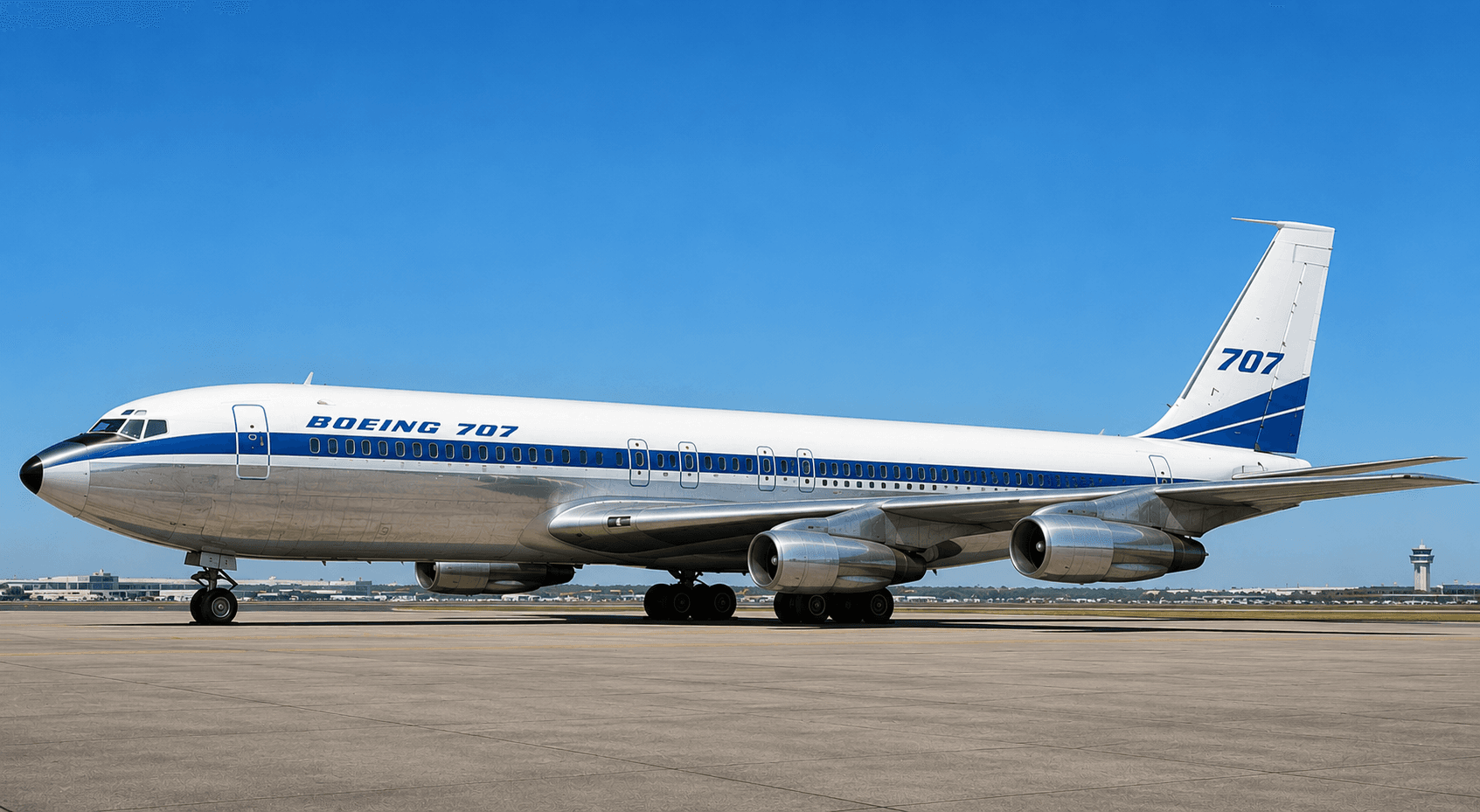
Boeing 727 – The Trijet That Revolutionized Medium-Haul Air Travel
Explore the Boeing 727, one of the most successful commercial aircraft ever built. Designed for airports with limited infrastructure, its three-engine configuration, advanced high-lift wing and rear airstair helped transform domestic aviation around the world.
- First flight
- 9 February 1963
- Introduced
- 1 February 1964 (Eastern Air Lines)
- Number built
- 1,832
- Range
- Up to 4,720 km (2,550 nautical miles)

Introduction
Overview
The Boeing 727 is one of the most iconic commercial aircraft ever produced and played a major role in expanding global air travel during the 1960s, 1970s and 1980s. Designed as a medium-range narrow-body airliner, the aircraft introduced a unique three-engine (trijet) configuration that combined excellent performance with the ability to operate from airports that lacked long runways or sophisticated ground infrastructure.
Developed to meet the joint requirements of United Airlines, American Airlines and Eastern Air Lines, the Boeing 727 was intended to bridge the gap between short-haul aircraft such as the Boeing 737 and long-range aircraft like the Boeing 707. Engineers designed the aircraft with exceptional short-field capability, integrated rear boarding stairs and a highly efficient high-lift wing, enabling airlines to serve smaller cities that previously had limited jet service.
The aircraft is instantly recognizable by its T-tail, three rear-mounted Pratt & Whitney JT8D turbofan engines and distinctive S-duct that feeds air into the center engine. These design features allowed the wings to remain aerodynamically clean while reducing foreign object damage at airports with less developed runways.
The Boeing 727 typically seats between 125 and 189 passengers depending on the variant and cabin configuration. It became the world's best-selling commercial jet for many years before eventually being surpassed by the Boeing 737.
A total of 1,832 Boeing 727 aircraft were produced, making it one of Boeing's most successful aircraft programs. Although passenger airlines have largely retired the aircraft, many Boeing 727s continue to serve as cargo freighters, VIP transports, military aircraft and research platforms, demonstrating the aircraft's remarkable durability and engineering excellence.
At a glance
- Type
- Narrow-body, Medium-Range Trijet Airliner
- Role
- Commercial Passenger Airliner
- Programme status
- Retired from Major Passenger Airlines (Active in Cargo & Charter Operations)
- Production
- 1962–1984
Primary operators
History
During the late 1950s, airlines sought a jet aircraft capable of serving medium-distance routes while operating from airports with relatively short runways. Many regional airports lacked long paved runways, jet bridges and specialized ground equipment, creating demand for a highly versatile aircraft.
Boeing responded by collaborating closely with three major U.S. airlines—United Airlines, American Airlines and Eastern Air Lines—to define the aircraft's requirements. United wanted excellent high-altitude performance for western U.S. operations, Eastern required outstanding short-field capability for airports along the East Coast, while American Airlines emphasized operational efficiency and passenger comfort.
After extensive studies, Boeing selected a three-engine layout. Two engines were mounted on either side of the rear fuselage, while a third engine was installed inside the tail and supplied through an innovative S-shaped air intake duct. This arrangement provided greater thrust than contemporary twin-engine aircraft while avoiding the fuel consumption associated with four-engine designs.
The Boeing 727 completed its maiden flight on 9 February 1963 and received FAA certification later that year. Eastern Air Lines introduced the aircraft into commercial service on 1 February 1964.
Passenger demand grew rapidly throughout the 1960s and 1970s. Airlines appreciated the aircraft's ability to serve airports that larger jets could not easily access, while passengers enjoyed faster travel times compared with piston-powered airliners.
In 1967 Boeing introduced the stretched Boeing 727-200, offering significantly greater passenger capacity. The improved 727-200 Advanced later became the most popular version, incorporating higher maximum takeoff weight, increased range and improved engine efficiency.
By the early 1980s the Boeing 727 had become one of the world's most recognizable aircraft and had established itself as the backbone of numerous airline fleets across North America, Europe, South America, Africa and Asia.
Production concluded in September 1984 after 1,832 aircraft had been manufactured. Although eventually replaced by more fuel-efficient twin-engine aircraft such as the Boeing 737 and Airbus A320 families, the Boeing 727 remains one of the most influential aircraft in aviation history.
Development
The Boeing 727 was developed during an era when commercial aviation was transitioning rapidly from piston-engine aircraft to jet-powered transportation. Boeing engineers faced the challenge of designing an aircraft capable of operating efficiently from airports with limited infrastructure while maintaining the speed and reliability expected of modern jet travel.
One of the programme's defining engineering decisions was the adoption of a trijet configuration powered by three Pratt & Whitney JT8D turbofan engines. At the time, engine reliability standards required additional redundancy for many commercial operations, making three engines an attractive compromise between performance, safety and operating economics.
Another major innovation was the aircraft's sophisticated high-lift wing. Engineers incorporated full-span leading-edge devices together with triple-slotted trailing-edge flaps, allowing the aircraft to generate exceptional lift during takeoff and landing. This enabled operations from significantly shorter runways than many competing jetliners.
To increase operational flexibility, Boeing integrated a retractable rear airstair beneath the tail. This unique feature allowed passengers to board or disembark without requiring airport stairs or jet bridges, making the Boeing 727 especially valuable at remote airports.
The aircraft was also designed with self-sufficiency in mind. Built-in loading equipment, robust landing gear and reliable systems enabled airlines to operate efficiently in developing regions where airport infrastructure was still evolving.
Continuous improvements throughout production resulted in several upgraded versions. The most successful, the Boeing 727-200 Advanced, featured improved JT8D engines, increased fuel capacity, higher maximum takeoff weight and extended operational range.
The Boeing 727 established new standards for medium-haul commercial aviation and influenced numerous future Boeing designs, particularly in aerodynamics, systems integration and airline operational efficiency.
Milestones
Programme Timeline
First flight
9 February 1963
Entered service
1 February 1964 (Eastern Air Lines)
Production
1962–1984
Retirement
Largely retired from passenger service; active in cargo and charter operations
Current status
Limited active service with cargo operators, charter airlines and government agencies
Aircraft Design
The Boeing 727 features one of the most distinctive designs ever introduced in commercial aviation. Its three rear-mounted engines, elegant T-tail and highly advanced high-lift wing made the aircraft instantly recognizable while providing exceptional operational performance.
The aircraft employs a conventional low-wing monoplane configuration with swept wings optimized for cruise speeds approaching Mach 0.90. The absence of underwing engines allowed engineers to design an exceptionally clean aerodynamic wing while reducing the likelihood of foreign object damage during operations from less developed airports.
Perhaps the Boeing 727's greatest aerodynamic achievement is its sophisticated high-lift system. Full-span leading-edge slats and Krueger flaps, combined with triple-slotted trailing-edge flaps, generate tremendous lift during takeoff and landing. This enables the aircraft to operate safely from relatively short runways while carrying substantial passenger loads.
The T-tail arrangement places the horizontal stabilizer above the engine exhaust, improving aerodynamic efficiency and ensuring clean airflow over the tail surfaces. The center engine receives air through an innovative S-shaped intake duct built into the vertical stabilizer, making the aircraft one of the few commercial airliners to use this engineering solution.
Constructed primarily from high-strength aluminum alloys, the Boeing 727 was designed to withstand decades of intensive airline operations. The robust airframe, durable landing gear and proven systems contributed to exceptional longevity, with many aircraft remaining in service for more than forty years.
One of the aircraft's most famous features is its retractable rear passenger stairway, which allows completely independent boarding and deplaning without external ground equipment. This capability made the Boeing 727 particularly attractive to airlines serving remote airports and military operators requiring maximum operational flexibility.
The Boeing 727 successfully combined innovative aerodynamics, structural strength and operational versatility, earning its reputation as one of the finest medium-range commercial aircraft ever built.
Cockpit
The Boeing 727 features a classic three-crew cockpit designed during an era when commercial airliners required a captain, first officer and flight engineer. While modern airliners rely heavily on computerized systems, the Boeing 727's flight deck combines conventional flight instruments with highly reliable mechanical, hydraulic and electrical systems that gave pilots exceptional control over the aircraft.
The cockpit was designed with excellent forward visibility through six large cockpit windows, enabling safe operations during takeoff, landing and taxiing. Controls are ergonomically arranged to allow the captain and first officer to manage flight operations efficiently, while the flight engineer monitored aircraft systems from a dedicated systems panel located behind and between the pilots.
Unlike modern glass cockpits, early Boeing 727 aircraft primarily used analog "steam gauge" instruments. Over time, many operators upgraded their aircraft with Electronic Flight Instrument Systems (EFIS), GPS navigation and modern communication equipment to comply with evolving air traffic management requirements.
Primary cockpit instruments include:
- Attitude Indicator
- Horizontal Situation Indicator (HSI)
- Airspeed Indicator
- Altimeter
- Vertical Speed Indicator
- Radio Magnetic Indicator (RMI)
- Engine Pressure Ratio (EPR) Indicators
- Navigation Displays (on upgraded aircraft)
- Weather Radar Display
- Flight Director System
- Autopilot Control Panel
The center pedestal houses the three-engine throttle quadrant, speed brake lever, flap controls and communication panels. The overhead panel contains electrical, hydraulic, pneumatic, anti-ice, lighting and fuel system controls, while the flight engineer's station provides detailed monitoring of aircraft systems including fuel balancing, engine parameters and environmental controls.
The Boeing 727's cockpit reflects the transition between the early jet age and modern airline automation. Although requiring three crew members, pilots continue to praise the aircraft for its excellent handling characteristics, intuitive control layout and responsive flight controls.
Cabin
The Boeing 727 cabin was designed to maximize passenger comfort while providing airlines with exceptional operational flexibility. Depending on the aircraft variant and airline configuration, the cabin accommodates between 125 and 189 passengers in single-class or mixed-class layouts.
A typical Boeing 727 passenger cabin features six-abreast seating arranged in a 3-3 configuration with a central aisle. Large windows provide natural lighting and excellent outside visibility, while overhead luggage bins offer convenient storage for passenger belongings.
One of the aircraft's distinguishing features was its integrated rear airstair, allowing passengers to board or disembark independently of airport equipment. This capability proved invaluable at regional airports, military bases and remote destinations where jet bridges were unavailable.
Typical cabin features include:
- 3-3 seating configuration
- Spacious overhead baggage bins
- Pressurized and climate-controlled cabin
- Multiple lavatories
- Forward and aft galleys
- Reading lights and individual air vents
- Large emergency exits
- Wide central aisle
- Sound-insulated passenger cabin
- Flexible seating layouts depending on airline requirements
The rear-mounted engine configuration helped reduce cabin noise in the forward section compared with underwing-engine aircraft of the same era. Airlines later modernized many Boeing 727 interiors with improved seating, upgraded lighting, new sidewall panels and enhanced in-flight service facilities.
Although designed more than six decades ago, the Boeing 727 cabin established standards that influenced numerous later Boeing aircraft, particularly in passenger flow, emergency evacuation and cabin flexibility.
Engines
The Boeing 727 is powered by three Pratt & Whitney JT8D low-bypass turbofan engines mounted at the rear of the fuselage. Two engines are installed externally on each side of the rear fuselage, while the third engine is located inside the tail and receives airflow through a distinctive S-shaped intake duct integrated into the vertical stabilizer.
The JT8D represented one of the most successful commercial turbofan engines ever developed. Throughout production, several JT8D variants were offered, producing between approximately 14,000 and 17,400 pounds of thrust depending on aircraft model and customer requirements.
Major advantages of the Pratt & Whitney JT8D include:
- Proven operational reliability
- Excellent thrust for medium-range operations
- Robust construction
- Easy maintenance access
- Strong takeoff performance
- Compatibility with multiple Boeing aircraft
- Long service history
- High dispatch reliability
The three-engine arrangement provided additional redundancy during an era when long overwater and mountainous operations often favored aircraft with more than two engines. It also enabled the Boeing 727 to operate safely from challenging airports requiring high climb performance.
The center engine installation remains one of the aircraft's most recognizable engineering features. Air enters through the vertical tail before passing through an S-shaped duct to the engine compressor. Although mechanically more complex than underwing engine installations, this arrangement contributed to excellent aerodynamic efficiency and helped keep the wings free from engine pylons.
Many later cargo operators upgraded engines with Stage III hush kits to comply with international airport noise regulations, extending the aircraft's commercial life well into the 21st century.
Flight Controls
The Boeing 727 employs conventional hydraulically powered flight controls that provide precise handling throughout all phases of flight. Although developed before fly-by-wire technology, the aircraft remains highly respected for its responsive handling and excellent low-speed performance.
Primary flight controls consist of:
- Ailerons
- Elevators
- Rudder
Secondary flight controls include:
- Full-span leading-edge slats
- Krueger flaps
- Triple-slotted trailing-edge flaps
- Ground spoilers
- Flight spoilers
- Speed brakes
- Roll, pitch and yaw trim systems
One of the Boeing 727's greatest engineering achievements is its sophisticated high-lift wing system. The combination of leading-edge devices and triple-slotted flaps dramatically increases lift during takeoff and landing, enabling operations from shorter runways than many competing aircraft.
Hydraulic power is supplied through multiple independent systems that provide redundancy for essential flight controls. In the event of a hydraulic failure, backup systems allow continued safe aircraft operation.
Spoilers perform several important functions including roll augmentation, descent control and lift dumping immediately after touchdown. The speed brake system enables rapid descent while maintaining acceptable airspeed limits.
Pilots consistently describe the Boeing 727 as one of Boeing's finest-handling commercial aircraft. Despite its size, the aircraft offers smooth roll response, stable cruise characteristics and excellent approach handling, making it a favorite among generations of airline crews.
Avionics
The Boeing 727 was originally equipped with advanced avionics for its era, combining analog flight instruments with sophisticated navigation and communication systems that enabled reliable all-weather airline operations.
Early production aircraft relied primarily on electromechanical instrumentation, while later upgrades introduced digital flight management systems, GPS navigation and electronic flight displays. Numerous cargo operators modernized their fleets with retrofit avionics packages to meet modern airspace requirements.
Typical avionics include:
- Collins Flight Director System
- Sperry SP-150 Autopilot
- VHF Communication Radios
- VOR Navigation Receivers
- Distance Measuring Equipment (DME)
- Instrument Landing System (ILS)
- Automatic Direction Finder (ADF)
- Weather Radar
- Marker Beacon Receiver
- Radio Altimeter
- Flight Data Recorder (FDR)
- Cockpit Voice Recorder (CVR)
- Transponder
- Traffic Collision Avoidance System (TCAS) on upgraded aircraft
- Enhanced Ground Proximity Warning System (EGPWS) on upgraded aircraft
- GPS/FMS (modernized aircraft)
The autopilot significantly reduced pilot workload during cruise, climb and instrument approaches, while the weather radar improved flight safety by allowing crews to avoid severe weather systems.
As international regulations evolved, many surviving Boeing 727 aircraft underwent avionics modernization programs that included glass cockpit displays, satellite navigation and digital communication equipment, allowing continued operation in modern controlled airspace.
Although based largely on analog technology, the Boeing 727 avionics proved exceptionally reliable and established many of the operational standards adopted by later Boeing commercial aircraft.
Landing Gear
The Boeing 727 features a hydraulically operated retractable tricycle landing gear system engineered for intensive airline service and operations from airports with varying runway conditions.
The landing gear consists of:
- Twin-wheel steerable nose landing gear
- Two four-wheel main landing gear assemblies
- Hydraulic retraction and extension system
- Anti-skid braking system
- Multiple-wheel carbon or steel brakes (depending on operator modifications)
- Oleo-pneumatic shock absorbers
Unlike many contemporary airliners, the Boeing 727 was specifically designed to operate from relatively short runways. Its robust landing gear absorbs heavy landing loads while providing excellent stability during taxi, takeoff and landing.
The main landing gear retracts into fuselage-mounted wheel wells beneath the wing root, while the nose gear retracts forward into the forward fuselage compartment. This arrangement contributes to reduced aerodynamic drag while protecting the landing gear during flight.
The anti-skid braking system continuously monitors wheel speed and automatically prevents tire lock-up during braking, particularly on wet or contaminated runways. Combined with the aircraft's advanced flap system and effective spoilers, this enables consistently short landing distances.
Designed for thousands of takeoff-and-landing cycles, the Boeing 727 landing gear became renowned for its durability and low maintenance requirements, contributing significantly to the aircraft's outstanding operational reliability throughout its decades of airline service.
Performance
The Boeing 727 was engineered to provide an ideal balance between speed, payload capacity and short-field performance. At the time of its introduction, it offered airlines the ability to serve medium-haul routes efficiently while operating from airports that lacked the long runways required by larger jetliners.
Powered by three Pratt & Whitney JT8D turbofan engines, the aircraft delivers excellent climb performance and cruise efficiency. Its sophisticated high-lift wing system enables safe operations from shorter runways without compromising passenger or cargo capacity.
Typical performance characteristics include:
- Cruise Speed: Approximately 965 km/h (521 knots, Mach 0.84)
- Maximum Speed: Approximately 1,013 km/h (Mach 0.90)
- Typical Cruise Altitude: 31,000–39,000 ft
- Service Ceiling: 42,000 ft
- Maximum Range:
- 727-100: Approximately 4,020 km (2,170 nautical miles) - 727-200 Advanced: Approximately 4,720 km (2,550 nautical miles)
The aircraft's advanced wing design, triple-slotted flaps and three-engine configuration provide exceptional takeoff performance, particularly at high-altitude airports and in hot weather conditions.
The Boeing 727 became especially popular among airlines operating frequent domestic services because of its quick turnaround capability, high dispatch reliability and ability to operate from airports with limited infrastructure.
Although modern twin-engine aircraft now offer greater fuel efficiency, the Boeing 727 remains one of the highest-performing classic narrow-body airliners ever produced.
Maintenance
The Boeing 727 earned an outstanding reputation for maintainability throughout its operational life. Designed during an era when aircraft routinely operated from airports with limited maintenance facilities, the aircraft incorporates accessible systems, robust components and proven engineering that simplified inspections and repairs.
Routine maintenance typically includes:
- Daily transit inspections
- Pre-flight walk-around inspections
- Scheduled A, B, C and D Maintenance Checks
- Pratt & Whitney JT8D engine inspections
- Landing gear servicing
- Hydraulic system inspections
- Flight control rigging checks
- Fuel system inspections
- Structural corrosion inspections
- Electrical system testing
- Pneumatic system servicing
- Cabin pressurization inspections
The aircraft's systems are arranged to allow maintenance personnel easy access to hydraulic lines, electrical equipment and avionics bays, reducing downtime during scheduled maintenance.
Cargo operators often implemented structural life-extension programs, corrosion prevention measures and avionics modernization packages to keep the aircraft economically viable for decades after passenger retirement.
Many Boeing 727 aircraft accumulated well over 80,000 flight hours and tens of thousands of flight cycles, demonstrating the exceptional durability of the airframe.
Even today, the Boeing 727 continues to serve cargo operators, government organizations and research agencies thanks to its rugged construction, proven systems and relatively straightforward maintenance procedures.
Safety
The Boeing 727 introduced numerous safety improvements over earlier commercial aircraft and established new standards for medium-haul airline operations. Throughout its long service life, the aircraft benefited from continuous upgrades in avionics, navigation systems and operational procedures.
Key safety features include:
- Three-engine redundancy
- Multiple independent hydraulic systems
- Independent electrical generation systems
- Fire detection and suppression systems
- Engine fire extinguishing systems
- Weather radar
- Instrument Landing System (ILS)
- Flight Director and Autopilot
- Cockpit Voice Recorder (CVR)
- Flight Data Recorder (FDR)
- Emergency escape slides
- Passenger oxygen systems
- Cargo compartment fire protection
- Anti-skid braking system
The aircraft's trijet configuration provided additional engine redundancy during an era when engine reliability was lower than today's standards. This made the Boeing 727 particularly attractive for operations over mountainous terrain and remote regions.
Over the years, many surviving aircraft received upgraded safety equipment including:
- Traffic Collision Avoidance System (TCAS)
- Enhanced Ground Proximity Warning System (EGPWS)
- GPS-based navigation
- Digital cockpit upgrades
- Modern weather radar
Although the Boeing 727 experienced several notable accidents during its long operational history, accident investigations led to significant improvements in crew training, air traffic control procedures, cockpit resource management (CRM) and aircraft design across the aviation industry.
Today, the Boeing 727 remains recognized as one of the safest and most influential classic commercial aircraft ever produced.
Reference
Technical Specifications
Full dimensional, weight, powerplant and performance data.
Crew & capacity
- Crew
- 3 (Captain, First Officer and Flight Engineer)
- Passengers
- 125–189 passengers depending on variant and airline configuration
Dimensions
- Length
- 46.69 m (153 ft 2 in) – 727-200 Advanced
- Wingspan
- 32.92 m (108 ft 0 in)
- Height
- 10.36 m (34 ft 0 in)
- Fuselage width
- 3.76 m (12 ft 4 in)
- Cabin width
- 3.51 m (11 ft 6 in)
- Wheelbase
- 21.34 m (70 ft)
Weights
- Empty weight
- Approximately 46,700 kg (102,900 lb)
- Operating weight
- Approximately 54,500 kg (120,200 lb)
- Max takeoff weight
- 95,030 kg (209,500 lb)
- Max landing weight
- 77,100 kg (170,000 lb)
- Max payload
- Approximately 24,000 kg (52,900 lb)
- Fuel capacity
- Approximately 43,500 L (11,490 US gal)
Powerplant
- Engines
- 3 × Pratt & Whitney JT8D Turbofan
- Engine manufacturer
- Pratt & Whitney
- Engine model
- JT8D-17R / JT8D-15 / JT8D-17 (variant dependent)
- Thrust
- 14,000–17,400 lbf (62–77 kN) each
Performance
- Maximum speed
- 1,013 km/h (Mach 0.90)
- Cruise speed
- 965 km/h (521 knots, Mach 0.84)
- Stall speed
- Approximately 204 km/h (110 knots)
- Range
- Up to 4,720 km (2,550 nautical miles)
- Service ceiling
- 42,000 ft (12,800 m)
- Rate of climb
- Approximately 2,700 ft/min (823 m/min)
- Takeoff distance
- Approximately 2,700 m (8,860 ft)
- Landing distance
- Approximately 1,650 m (5,410 ft)
Fuel & operating limits
- Fuel consumption
- Approximately 4,800–5,800 L/hour depending on payload, variant and flight profile
- Endurance
- Approximately 5–6 hours
- Maximum altitude
- 42,000 ft
- Max operating Mach
- Mach 0.90
- Runway requirement
- Typically 2,200–2,700 m depending on aircraft weight, airport elevation and environmental conditions
Programme
- First flight
- 9 February 1963
- Introduction
- 1 February 1964 (Eastern Air Lines)
- Production years
- 1962–1984
- Number built
- 1,832
- Unit cost
- Approximately US$22–24 million (1980s value)
Variants
Boeing 727-100
The original production variant introduced in 1964. It typically seated between 106 and 131 passengers and was designed for medium-range routes with excellent short-field performance. Powered by three Pratt & Whitney JT8D turbofan engines.
Boeing 727-100C
A convertible passenger/freighter version featuring a large side cargo door and reinforced cabin floor. Airlines could quickly reconfigure the aircraft between passenger and cargo operations.
Boeing 727-100QC (Quick Change)
Designed for rapid conversion between passenger and cargo service. The Quick Change version used removable passenger seats mounted on pallets, allowing operators to switch configurations in only a few hours.
Boeing 727-100QF
A dedicated cargo conversion of the 727-100 featuring a strengthened main deck floor, large cargo door and freight handling system. Many former passenger aircraft were later converted into freighters.
Boeing 727-200
A stretched version introduced in 1967 with approximately six meters (20 feet) of additional fuselage length. Passenger capacity increased to as many as 189 passengers depending on cabin configuration, making it significantly more economical for airlines.
Boeing 727-200 Advanced
The most successful production model featuring upgraded Pratt & Whitney JT8D engines, increased maximum takeoff weight, larger fuel capacity, improved range and enhanced operating economics. Most Boeing 727 aircraft built were this variant.
Boeing 727 Freighter
Numerous passenger aircraft were converted into dedicated cargo freighters with reinforced floors, powered cargo loading systems and large main deck cargo doors. These aircraft continue to serve freight operators worldwide.
Military & Government Variants
Several Boeing 727 aircraft were modified for military transport, VIP transport, calibration duties, research missions and government operations by various countries around the world.
Major Operators
- Eastern Air Lines (Launch Customer)
- United Airlines
- American Airlines
- Delta Air Lines
- Northwest Airlines
- Pan American World Airways (Pan Am)
- Lufthansa
- British Airways
- Air France
- Japan Air Lines (JAL)
- Korean Air
- Avianca
- Mexicana
- FedEx Express
- UPS Airlines
- DHL Aviation
- Saudi Arabian Airlines
- Iberia
- Varig
- Air Afrique
Advantages & Limitations
Advantages
- One of the most successful commercial aircraft ever built with 1,832 aircraft produced.
- Excellent short-field performance due to its sophisticated high-lift wing design.
- Three-engine configuration provided outstanding climb performance and engine redundancy.
- Capable of operating from airports with limited infrastructure and shorter runways.
- Integrated rear airstair allowed completely independent passenger boarding without ground equipment.
- Highly reliable Pratt & Whitney JT8D engines with decades of proven operational service.
- Robust airframe capable of remaining in service for more than 40 years.
- Excellent dispatch reliability during intensive airline operations.
- Highly versatile platform adaptable for passenger, cargo, military and VIP missions.
- Strong payload capability for medium-range routes.
- Cargo conversions significantly extended the aircraft's commercial service life.
- Easy access for maintenance personnel due to well-designed aircraft systems.
- Outstanding handling characteristics highly regarded by airline pilots.
- Excellent hot-and-high airport performance compared with many contemporary aircraft.
- Established operational standards that influenced later Boeing aircraft designs.
Limitations
- Three engines resulted in significantly higher fuel consumption than modern twin-engine aircraft.
- Required a three-person flight crew, increasing operating costs.
- Older JT8D engines produced higher noise levels than newer high-bypass turbofan engines.
- Higher maintenance costs due to the additional center engine and complex S-duct intake.
- Did not meet modern Stage 4 and Stage 5 airport noise regulations without modifications.
- Higher emissions compared with next-generation commercial aircraft.
- Limited fuel efficiency made operations increasingly uneconomical after rising fuel prices.
- Analog cockpit required greater pilot workload than modern glass cockpit aircraft.
- Replacement spare parts became increasingly difficult to source as fleets were retired.
- Longer maintenance times compared with newer aircraft featuring modular digital systems.
- Cargo conversions reduced availability of passenger aircraft in later years.
- Eventually replaced by more efficient aircraft such as the Boeing 737 Next Generation and Airbus A320 family.
Interesting Facts
- The Boeing 727 was Boeing's best-selling commercial jet until it was surpassed by the Boeing 737.
- A total of 1,832 Boeing 727 aircraft were produced between 1962 and 1984.
- The aircraft features three Pratt & Whitney JT8D engines, making it one of the world's most recognizable trijets.
- The center engine receives air through a distinctive S-shaped intake duct built into the vertical tail.
- The Boeing 727 introduced one of the most advanced high-lift wing systems of its time.
- Its triple-slotted flaps became famous for providing exceptional short-runway performance.
- The aircraft was designed jointly to satisfy the requirements of United Airlines, American Airlines and Eastern Air Lines.
- The integrated rear airstair allowed passengers to board without airport stairs or jet bridges.
- The rear stair became widely known after the famous 1971 D.B. Cooper hijacking, where the hijacker parachuted from the aircraft in flight.
- Many Boeing 727 aircraft accumulated more than 100,000 flight hours during their operational careers.
- Several 727s continue flying today as cargo aircraft, research platforms and government transports.
- NASA has operated modified Boeing 727 aircraft for airborne scientific research.
- The Boeing 727 was one of the first commercial aircraft capable of serving many smaller regional airports with jet service.
- Cargo operators such as FedEx and UPS relied heavily on converted Boeing 727 freighters for decades.
- Many aviation enthusiasts consider the Boeing 727 one of the most beautiful and iconic airliner designs ever produced.
Comparison
Versus the Douglas DC-9
- The Boeing 727 features three engines, while the Douglas DC-9 uses two rear-mounted engines.
- The Boeing 727 offers significantly greater passenger capacity and range.
- The 727's sophisticated triple-slotted flaps provide superior short-field performance.
- The Boeing 727 incorporates an integrated rear airstair, allowing operations without airport boarding equipment.
- The 727 was designed for medium-range routes, whereas the DC-9 primarily serves short-haul operations.
- The Boeing 727's maximum takeoff weight is considerably higher, enabling greater payload capability.
- The 727 became one of the world's most successful cargo conversion aircraft.
- Both aircraft influenced commercial aviation during the 1960s and remain iconic examples of classic jetliner design.
Interactive
Explore the Aircraft
Hover or tap a marker to identify each major part of the aircraft.
Select a marker to learn about each part of the aircraft.
Gallery

Boeing 727 side profile highlighting its distinctive trijet configuration and T-tail. 
Classic Boeing 727 cockpit with Captain, First Officer and Flight Engineer stations. 
Typical Boeing 727 passenger cabin arranged in a 3-3 seating configuration. 
Pratt & Whitney JT8D turbofan engine mounted on the rear fuselage. 
The Boeing 727's famous retractable rear airstair, allowing independent passenger boarding. 
A converted Boeing 727 freighter continuing service with a cargo operator.
Frequently Asked Questions
Recommended Products
Boeing 707 History Book
Comprehensive reference covering the design, development and operational history of the Boeing 707.
Buy now
Commercial Aircraft Encyclopedia
A detailed guide covering classic and modern commercial aircraft.
Buy now


As an affiliate, A2Z InfoSight may earn from qualifying purchases.
References
Keep exploring