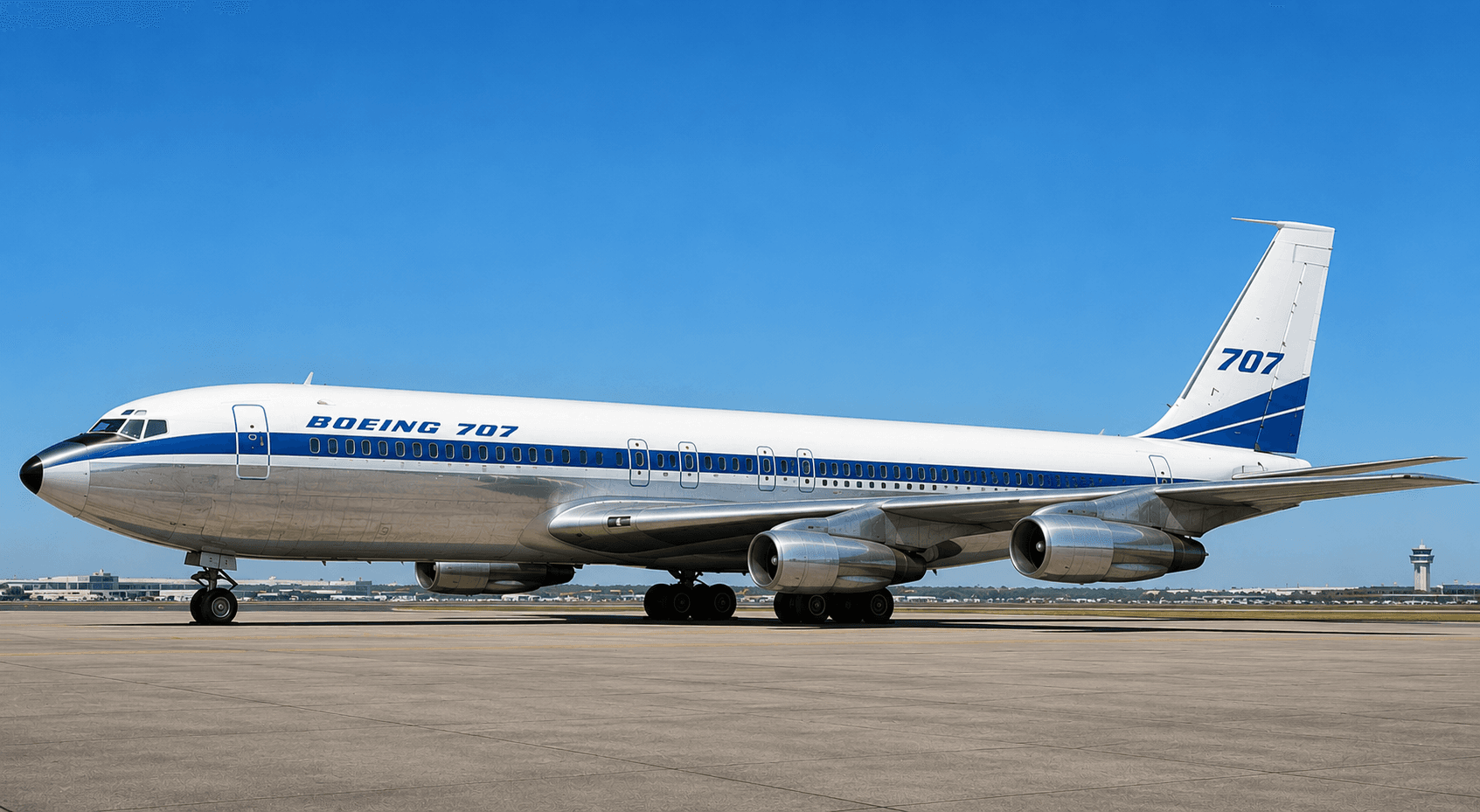
Boeing 737 Original – The Aircraft That Changed Short-Haul Aviation
Discover the Boeing 737 Original family, including the iconic 737-100 and 737-200 that laid the foundation for the world's best-selling commercial aircraft family.
- First flight
- 9 April 1967
- Introduced
- 10 February 1968 (Lufthansa)
- Number built
- 1,114
- Range
- 4,000 km (2,160 nautical miles)

Introduction
Overview
The Boeing 737 Original is the first generation of the Boeing 737 family and includes the Boeing 737-100 and Boeing 737-200 variants. Developed during the 1960s to meet growing airline demand for a compact, economical jet airliner, the aircraft revolutionized short-haul commercial aviation and laid the foundation for what would become the world's best-selling commercial aircraft family.
Designed with twin Pratt & Whitney JT8D turbofan engines mounted beneath low-swept wings, the Boeing 737 introduced several innovative features for its time, including a low ground clearance that simplified passenger boarding and maintenance by reducing dependence on airport infrastructure.
The Boeing 737 Original typically accommodated between 85 and 130 passengers depending on configuration and became popular among airlines for its reliability, economical operation and ability to operate from smaller airports.
Its success encouraged Boeing to develop subsequent generations, including the 737 Classic, 737 Next Generation (NG) and 737 MAX families. Collectively, these aircraft transformed the Boeing 737 into the most successful commercial aircraft programme in aviation history.
Although most Boeing 737 Original aircraft have now retired from passenger service, many continued operating for decades in cargo, charter, military and research roles, demonstrating the remarkable durability and engineering excellence of the original design.
At a glance
- Type
- Narrow-body Twin-Engine Jet Airliner
- Role
- Short-to-Medium Range Passenger Airliner
- Programme status
- Retired from Mainstream Passenger Service
- Production
- 1966–1988
Primary operators
History
During the early 1960s, Boeing recognized an increasing demand for a short-range jet capable of serving regional routes more economically than larger aircraft such as the Boeing 707 and Boeing 727. European manufacturers, including BAC with the One-Eleven and Douglas with the DC-9, had already entered this emerging market, prompting Boeing to develop its own competitor.
The Boeing 737 programme officially began in 1964. Engineers designed the aircraft to maximize operational efficiency while minimizing airport infrastructure requirements. A defining feature was its low-mounted engines, allowing passengers to board using built-in stairs at airports lacking jet bridges.
The Boeing 737-100 completed its maiden flight on 9 April 1967 and entered commercial service with Lufthansa on 10 February 1968, becoming the launch customer. Although technically successful, airlines preferred a slightly larger version with greater passenger capacity and range.
This led to the Boeing 737-200, which featured a longer fuselage, increased seating capacity and improved economics. The 737-200 quickly became the dominant member of the Original family and established the Boeing 737 as one of the most popular commercial aircraft ever produced.
Throughout the 1970s and 1980s, hundreds of Boeing 737 Original aircraft entered service worldwide. Their success ultimately inspired every subsequent generation of the Boeing 737 family.
Development
The Boeing 737 was conceived as a complementary aircraft to Boeing's larger jetliners, offering airlines an efficient solution for short- and medium-haul routes with lower passenger demand.
Unlike many competing aircraft of the era, Boeing chose to mount the Pratt & Whitney JT8D engines directly beneath the wings rather than on the rear fuselage. This reduced structural complexity, improved maintenance accessibility and enabled easier inspection by ground crews.
Engineers also designed the aircraft with exceptional commonality to other Boeing aircraft wherever practical, simplifying pilot training and airline maintenance programmes.
As airline requirements evolved, Boeing introduced the stretched 737-200, which became significantly more popular than the shorter 737-100. Continuous improvements were later incorporated through Advanced variants featuring increased fuel capacity, more powerful engines, improved aerodynamics and upgraded avionics.
The engineering principles established during development—including structural durability, maintainability and operational flexibility—remain evident in every subsequent Boeing 737 generation, making the Original series one of the most influential commercial aircraft ever developed.
Milestones
Programme Timeline
First flight
9 April 1967
Entered service
10 February 1968 (Lufthansa)
Production
1966–1988
Retirement
Mostly retired from passenger service; limited cargo and special-mission operators remain
Current status
Largely retired; limited cargo, military and research operations continue
Aircraft Design
The Boeing 737 Original introduced an innovative design philosophy that prioritized simplicity, efficiency and operational flexibility. As Boeing's first dedicated short-haul twin-engine airliner, it was engineered to provide airlines with an economical aircraft capable of operating from airports with limited infrastructure while maintaining high reliability and low operating costs.
Unlike many contemporary aircraft that featured rear-mounted engines, the Boeing 737 Original adopted a conventional low-wing configuration with two Pratt & Whitney JT8D turbofan engines mounted directly beneath the wings. This arrangement simplified maintenance, reduced structural weight and improved engine accessibility for ground crews.
One of the aircraft's most distinctive design features was its exceptionally low ground clearance. This allowed baggage loading, catering and passenger boarding to be performed without specialized airport equipment, making the aircraft particularly attractive to airlines operating from smaller regional airports.
The aircraft features a swept wing with approximately 25 degrees of sweepback, optimized for cruise speeds around Mach 0.74 to Mach 0.78 while maintaining excellent low-speed handling during takeoff and landing. High-lift devices, including leading-edge slats and double-slotted trailing-edge flaps, provide excellent short-field performance.
Constructed primarily from lightweight aluminum alloys, the fuselage was designed using fail-safe structural principles to withstand thousands of pressurization cycles throughout its operational life. The circular fuselage cross-section maximized passenger comfort while maintaining structural efficiency.
The Boeing 737 Original established the basic airframe architecture that would later evolve into the Classic, Next Generation and MAX families, making it one of the most influential aircraft designs in commercial aviation history.
Cockpit
The Boeing 737 Original featured a conventional analog cockpit typical of commercial aircraft developed during the 1960s. The flight deck was designed for two pilots while providing space for an optional observer seat, with flight controls arranged ergonomically to reduce workload during all phases of flight.
Primary flight instruments consisted of electromechanical gauges displaying attitude, altitude, airspeed, vertical speed, engine parameters and navigation information. The instrument panel was logically organized to allow pilots to quickly monitor aircraft performance while maintaining excellent situational awareness.
Typical cockpit equipment included:
- Captain and First Officer flight instrument panels
- Electromechanical engine instruments
- VHF communication radios
- VOR/DME navigation receivers
- Automatic Direction Finder (ADF)
- Instrument Landing System (ILS)
- Weather Radar
- Autopilot (operator dependent)
- Flight Director System
- Engine Fire Detection System
- Central Warning Panel
The center pedestal housed throttle levers, flap controls, speed brake lever, trim controls and radio tuning panels, while the overhead panel provided access to electrical, hydraulic, fuel, pneumatic and environmental control systems.
Later Boeing 737-200 Advanced aircraft introduced improved avionics, enhanced autopilot capabilities and optional Flight Management Systems, allowing operators to modernize their aircraft while extending operational life.
Despite its analog nature, pilots praised the Boeing 737 Original cockpit for its logical layout, excellent visibility and straightforward systems, making it one of the easiest commercial aircraft of its era to operate.
Cabin
The Boeing 737 Original cabin was designed to maximize passenger comfort while providing airlines with flexible seating arrangements for regional and domestic operations. Depending on the variant and operator, the aircraft typically accommodated between 85 and 130 passengers.
The cabin adopted the now-familiar six-abreast seating configuration arranged in a 3-3 layout with a single central aisle. This arrangement became a defining characteristic of every subsequent Boeing 737 generation and remains the industry standard for narrow-body aircraft.
Cabin features included:
- Six-abreast seating configuration
- Large passenger windows
- Spacious overhead hat racks (later enlarged by some operators)
- Pressurized and air-conditioned cabin
- Forward and aft galleys
- Passenger service units with reading lights and air vents
- Multiple emergency exits
- Flexible single-class and dual-class layouts
The Boeing 737's low fuselage height significantly simplified passenger boarding, allowing many airports to use built-in airstairs instead of expensive boarding bridges.
Although cabin interiors reflected the design standards of the late 1960s and 1970s, many operators modernized their aircraft with updated seating, LED lighting and refurbished interiors during later years of service.
The efficient cabin layout contributed significantly to the aircraft's popularity among airlines operating high-frequency short-haul services.
Engines
The Boeing 737 Original family is powered by two Pratt & Whitney JT8D low-bypass turbofan engines mounted beneath the wings. At the time of its introduction, the JT8D represented one of the most reliable commercial jet engines available and became one of the most successful turbofan engines ever produced.
Different Boeing 737 Original variants were equipped with several JT8D engine models producing between approximately 14,000 and 17,400 pounds of thrust.
Key engine characteristics include:
- Pratt & Whitney JT8D low-bypass turbofan
- Reliable mechanical design
- Excellent durability
- Easy maintenance access
- Proven worldwide support network
- Suitable for high-cycle airline operations
Compared with modern high-bypass engines, the JT8D consumed more fuel and generated higher external noise levels. However, during its era it offered outstanding reliability and significantly improved efficiency over earlier turbojet engines.
The underwing engine installation simplified inspection and maintenance while contributing to reduced operating costs compared with rear-mounted engine configurations.
Many Boeing 737-200 Advanced aircraft later received upgraded JT8D variants that improved fuel efficiency, climb performance and reliability while complying with evolving operational requirements.
Flight Controls
The Boeing 737 Original utilizes conventional mechanically controlled flight controls with hydraulic power assistance, providing pilots with direct aircraft feedback while ensuring reliable operation under all flight conditions.
Primary flight controls include:
- Ailerons
- Elevators
- Rudder
Secondary flight controls include:
- Leading-edge slats
- Double-slotted trailing-edge flaps
- Flight spoilers
- Ground spoilers
- Speed brakes
- Elevator trim
- Rudder trim
- Aileron trim
Dual hydraulic systems provide power to the primary flight control surfaces while ensuring redundancy in the event of component failures.
The aircraft's flap system provides substantial lift during takeoff and landing, allowing safe operation from relatively short runways. Spoilers assist roll control during flight and automatically deploy after touchdown to reduce lift and improve braking effectiveness.
The Boeing 737 Original is widely regarded as having predictable handling characteristics, responsive controls and excellent low-speed stability. These qualities made it particularly popular with pilots and established a handling philosophy that has been preserved throughout subsequent generations of the Boeing 737 family.
Avionics
The Boeing 737 Original was equipped with one of the most advanced avionics suites available during the late 1960s. While today's flight decks are dominated by digital displays and integrated flight management systems, the original Boeing 737 relied primarily on analog instrumentation combined with reliable radio navigation equipment.
The cockpit incorporated conventional electromechanical flight instruments supported by radio navigation aids that enabled safe operations under both visual and instrument flight rules (IFR). As technology evolved, many Boeing 737-200 aircraft were upgraded with modern avionics packages to comply with changing air traffic management requirements.
Typical avionics installed on the Boeing 737 Original included:
- Analog Primary Flight Instruments
- Dual VHF Communication Radios
- VOR Navigation Receivers
- Distance Measuring Equipment (DME)
- Automatic Direction Finder (ADF)
- Instrument Landing System (ILS)
- Marker Beacon Receiver
- Weather Radar
- Flight Director System
- Autopilot (operator dependent)
- Radio Altimeter
- Ground Proximity Warning System (later aircraft)
- Traffic Collision Avoidance System (retrofitted on many aircraft)
- Cockpit Voice Recorder (CVR)
- Flight Data Recorder (FDR)
Although lacking today's glass cockpit technology, the avionics proved exceptionally reliable and easy to maintain. Numerous operators later modernized their fleets by installing GPS navigation, digital flight displays and upgraded communication systems, significantly extending the operational life of the aircraft.
Landing Gear
The Boeing 737 Original features a hydraulically operated retractable tricycle landing gear designed for reliability, ease of maintenance and frequent airline operations.
The landing gear configuration consists of:
- Twin-wheel nose landing gear
- Dual-wheel main landing gear assemblies
- Hydraulic retraction and extension
- Anti-skid braking system
- Hydraulic steering
- Oleo-pneumatic shock absorbers
One of the Boeing 737's distinguishing features is its low landing gear height. Unlike many contemporary jetliners, the aircraft sits close to the ground, allowing passengers to board using built-in stairs and enabling baggage loading without specialized equipment.
The main landing gear retracts inward into enclosed fuselage bays while the nose gear retracts forward beneath the cockpit. This compact arrangement contributed to the aircraft's clean aerodynamic profile while simplifying maintenance.
The robust landing gear design enabled the aircraft to perform thousands of takeoff-and-landing cycles during its operational life, making it particularly suitable for high-frequency domestic routes.
Even decades after entering service, many Boeing 737 Original aircraft continued operating from challenging airports around the world thanks to the durability of their landing gear systems.
Performance
The Boeing 737 Original established new standards for operational efficiency in the short-haul commercial aviation market. Designed for sectors ranging from approximately 300 to 2,500 nautical miles, it combined economical fuel consumption with dependable performance.
Typical Boeing 737-200 Advanced performance includes:
- Cruise Speed: Approximately 780 km/h (Mach 0.74)
- Maximum Speed: Approximately 876 km/h (Mach 0.82)
- Service Ceiling: 37,000 ft
- Typical Cruise Altitude: 31,000–37,000 ft
- Maximum Range: Approximately 4,000 km (2,160 nautical miles)
Powered by Pratt & Whitney JT8D engines, the aircraft demonstrated excellent climb performance and dependable operation under a wide range of environmental conditions.
The aircraft's high-lift wing design enabled safe operation from relatively short runways, making it attractive to airlines serving regional airports with limited infrastructure.
Later Boeing 737-200 Advanced variants incorporated aerodynamic refinements and more powerful engine options that improved payload capability, takeoff performance and operating economics.
The aircraft's ability to combine reliability, simplicity and performance contributed significantly to the Boeing 737's worldwide success.
Maintenance
The Boeing 737 Original earned an excellent reputation for maintainability, becoming one of the easiest commercial aircraft of its era to service. Boeing designed the aircraft to minimize maintenance downtime while simplifying routine inspections and repairs.
Routine maintenance activities include:
- Daily transit inspections
- Pre-flight external inspections
- Scheduled A Checks
- C Checks
- Heavy structural inspections
- Engine borescope inspections
- Landing gear servicing
- Brake wear inspections
- Hydraulic system maintenance
- Electrical system testing
- Fuel system inspections
- Corrosion prevention programmes
The aircraft's low ground clearance allows technicians to access engines, landing gear and lower fuselage components without extensive ground support equipment, reducing maintenance costs.
The Pratt & Whitney JT8D engines are modular in design and have accumulated millions of operating hours worldwide, resulting in extensive maintenance knowledge and readily available spare parts.
Many Boeing 737 Original aircraft remained economically viable for decades because of their simple systems, durable structure and excellent maintenance support network.
Safety
The Boeing 737 Original was designed to meet the highest commercial aviation safety standards of its era. Throughout its operational life, continuous improvements in avionics, maintenance procedures and pilot training contributed to its strong safety record.
Key safety systems include:
- Dual hydraulic systems
- Dual electrical generation systems
- Engine fire detection and suppression
- Cargo fire protection
- Emergency oxygen systems
- Anti-skid braking
- Flight data recorder
- Cockpit voice recorder
- Stall warning system
- Ice protection system
- Weather radar
- Emergency escape slides
- Multiple emergency exits
Later aircraft and many retrofitted fleets incorporated additional safety equipment including:
- Ground Proximity Warning System (GPWS)
- Traffic Collision Avoidance System (TCAS)
- Enhanced navigation systems
- GPS-based flight management
The Boeing 737 Original also benefited from decades of continuous improvements based on operational experience, making it one of the safest short-haul commercial aircraft of its generation.
Its robust structural design, dependable Pratt & Whitney JT8D engines and proven systems laid the foundation for the exceptional safety reputation enjoyed by every subsequent generation of the Boeing 737 family.
Reference
Technical Specifications
Full dimensional, weight, powerplant and performance data.
Crew & capacity
- Crew
- 2 (Captain and First Officer) + Cabin Crew
- Passengers
- 85–130 passengers depending on airline configuration
Dimensions
- Length
- 30.53 m (100 ft 2 in)
- Wingspan
- 28.35 m (93 ft 0 in)
- Height
- 11.23 m (36 ft 10 in)
- Fuselage width
- 3.76 m (12 ft 4 in)
- Cabin width
- 3.54 m (11 ft 7 in)
- Wheelbase
- 10.16 m (33 ft 4 in)
Weights
- Empty weight
- Approximately 28,120 kg (62,000 lb)
- Operating weight
- Approximately 31,800 kg (70,100 lb)
- Max takeoff weight
- 52,390 kg (115,500 lb)
- Max landing weight
- 46,720 kg (103,000 lb)
- Max payload
- 13,600 kg (30,000 lb)
- Fuel capacity
- 22,720 L (6,000 US gal)
Powerplant
- Engines
- 2 × Pratt & Whitney JT8D Low-Bypass Turbofan
- Engine manufacturer
- Pratt & Whitney
- Engine model
- JT8D-17 / JT8D-17A
- Thrust
- 16,400 lbf (72.9 kN) each
Performance
- Maximum speed
- 876 km/h (Mach 0.82)
- Cruise speed
- 780 km/h (421 knots, Mach 0.74)
- Stall speed
- Approximately 204 km/h (110 knots)
- Range
- 4,000 km (2,160 nautical miles)
- Service ceiling
- 37,000 ft (11,278 m)
- Rate of climb
- Approximately 2,600 ft/min (792 m/min)
- Takeoff distance
- Approximately 2,090 m (6,860 ft)
- Landing distance
- Approximately 1,400 m (4,590 ft)
Fuel & operating limits
- Fuel consumption
- Approximately 2,800–3,100 L/hour depending on payload and flight profile
- Endurance
- Up to 5.5 hours
- Maximum altitude
- 37,000 ft
- Max operating Mach
- Mach 0.82
- Runway requirement
- Typically 1,900–2,300 m depending on aircraft weight, temperature and elevation
Programme
- First flight
- 9 April 1967
- Introduction
- 10 February 1968 (Lufthansa)
- Production years
- 1966–1988
- Number built
- 1,114
- Unit cost
- Approximately US$8.5 million (1972 list price)
Variants
Boeing 737-100
The original production version of the Boeing 737. Designed to accommodate approximately 85 to 100 passengers, only 30 aircraft were built. Lufthansa became the launch customer and remained the primary operator.
Boeing 737-200
A stretched version featuring increased passenger capacity, greater fuel capacity and improved economics. It became the most successful member of the Original family with more than 1,000 aircraft produced.
Boeing 737-200 Advanced
Introduced in 1971, this improved variant featured more powerful Pratt & Whitney JT8D engines, increased fuel capacity, aerodynamic refinements, improved avionics and significantly better operating economics.
Boeing 737-200C
A convertible passenger and cargo version equipped with a large side cargo door, allowing rapid conversion between passenger and freight configurations.
Boeing 737-200QC
Quick Change variant designed for operators requiring rapid conversion between passenger and cargo operations, often completed within approximately one hour.
Boeing T-43A
Military navigation trainer developed for the United States Air Force. Based on the Boeing 737-200, it trained navigators for several decades before retirement.
NASA 737 Flying Laboratory
Several Boeing 737-200 aircraft have been modified by NASA for aviation research, systems testing and airborne scientific experiments.
Major Operators
- Lufthansa
- United Airlines
- Air Canada
- Western Airlines
- Piedmont Airlines
- Frontier Airlines
- Alaska Airlines
- Southwest Airlines
- America West Airlines
- Canadian North
- Air Inuit
- Nolinor Aviation
- NASA
- United States Air Force (T-43A)
- Indonesian Air Force
Advantages & Limitations
Advantages
- First member of the world's most successful commercial aircraft family.
- Simple and highly reliable aircraft systems reduced maintenance complexity.
- Excellent dispatch reliability throughout its operational life.
- Low-mounted engines simplified maintenance and inspections.
- Low ground clearance enabled operations at airports with minimal infrastructure.
- Strong structural design capable of decades of high-cycle operations.
- Excellent short- and medium-haul performance.
- Proven Pratt & Whitney JT8D engines with worldwide maintenance support.
- Flexible passenger, cargo and military variants expanded operational capability.
- Established the design philosophy that continues throughout every Boeing 737 generation.
Limitations
- Higher fuel consumption compared with modern high-bypass turbofan aircraft.
- JT8D engines produced significantly higher external noise levels.
- Limited passenger capacity compared with later Boeing 737 variants.
- Analog cockpit required higher pilot workload than modern glass cockpits.
- Older navigation systems required extensive upgrades to meet modern airspace requirements.
- Lower range than the Boeing 737 Classic, NG and MAX families.
- Smaller overhead baggage storage compared with later aircraft.
- Reduced cargo volume because of the shorter fuselage.
- Production ended in 1988, limiting availability of new airframes.
- Many aircraft require significant modernization to remain economically competitive.
Interesting Facts
- The Boeing 737 Original completed its first flight on 9 April 1967.
- Lufthansa became the launch customer for the Boeing 737.
- Only 30 Boeing 737-100 aircraft were produced.
- The Boeing 737-200 became one of the most successful short-haul aircraft of its era.
- The aircraft introduced Boeing's now-famous six-abreast narrow-body cabin layout.
- The Boeing 737's low ground clearance allowed passengers to board without jet bridges.
- The Original family established the structural design still visible in today's Boeing 737 MAX.
- Pratt & Whitney JT8D engines powered every Boeing 737 Original.
- Several Boeing 737-200 aircraft continue flying as cargo and combi aircraft.
- The United States Air Force operated the T-43A navigation trainer based on the Boeing 737-200.
- NASA continues to use modified Boeing 737 aircraft for aviation research.
- The Boeing 737 became Boeing's best-selling commercial aircraft programme in history.
- The aircraft has operated on every inhabited continent.
- Many Boeing 737-200 aircraft successfully operated in Arctic environments.
- The Boeing 737 Original laid the foundation for more than 11,000 Boeing 737 aircraft delivered worldwide.
Comparison
Versus the McDonnell Douglas DC-9
- The Boeing 737 uses underwing-mounted engines, while the DC-9 uses rear-mounted engines.
- The Boeing 737 offers six-abreast seating compared with the DC-9's five-abreast cabin.
- The Boeing 737 features lower ground clearance for simplified airport operations.
- The DC-9 generally provides a quieter forward cabin because of its rear-mounted engines.
- The Boeing 737 became the foundation for the world's highest-selling commercial aircraft family.
- The DC-9 evolved into the MD-80, MD-90 and ultimately the Boeing 717.
- Both aircraft demonstrated exceptional reliability and transformed short-haul commercial aviation.
- The Boeing 737 family remains in production today, while DC-9 production ended decades ago.
Interactive
Explore the Aircraft
Hover or tap a marker to identify each major part of the aircraft.
Select a marker to learn about each part of the aircraft.
Gallery

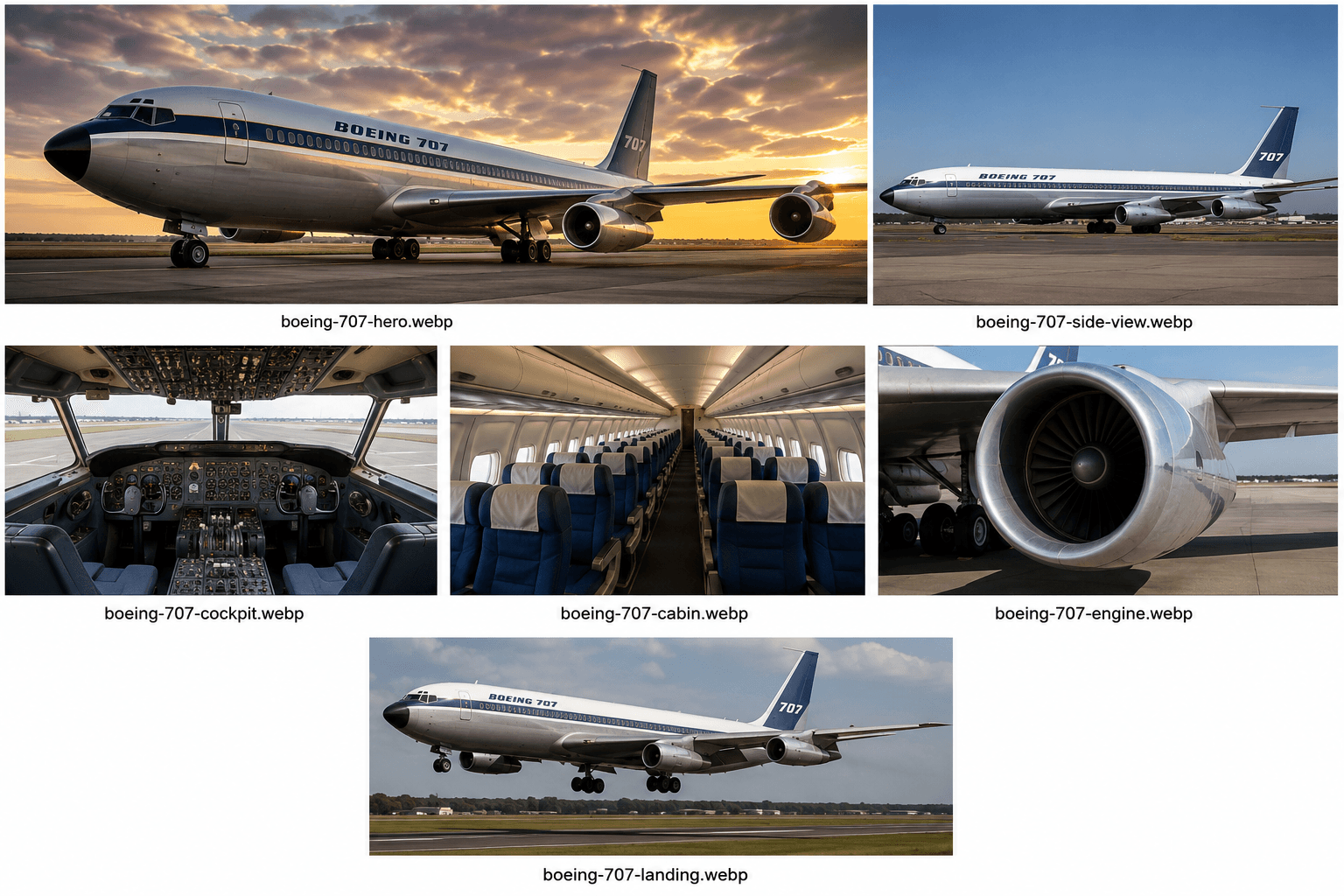
Boeing 737-200 side profile showing the original JT8D engine installation and classic fuselage design. 
Traditional analog cockpit of the Boeing 737 Original featuring electromechanical flight instruments. 
Passenger cabin configured with the classic six-abreast (3-3) seating layout. 
Pratt & Whitney JT8D low-bypass turbofan engine mounted beneath the wing. 
Boeing 737-200 Advanced during landing with landing gear fully extended.
Frequently Asked Questions
Recommended Products
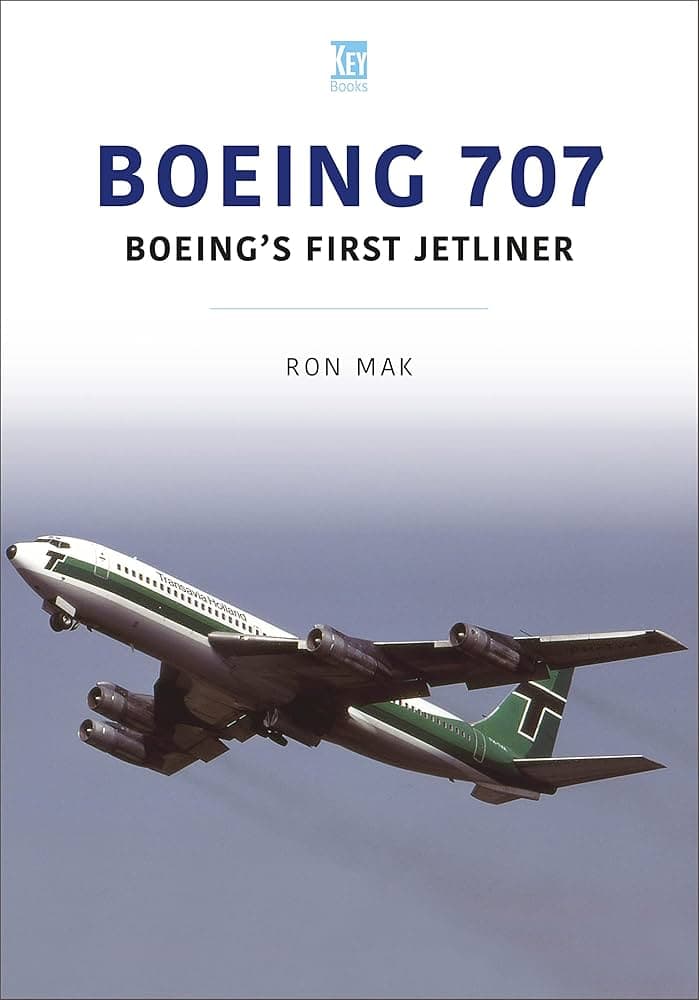
Boeing 707 History Book
Comprehensive reference covering the design, development and operational history of the Boeing 707.
Buy now
Commercial Aircraft Encyclopedia
A detailed guide covering classic and modern commercial aircraft.
Buy now


As an affiliate, A2Z InfoSight may earn from qualifying purchases.
References
Keep exploring